

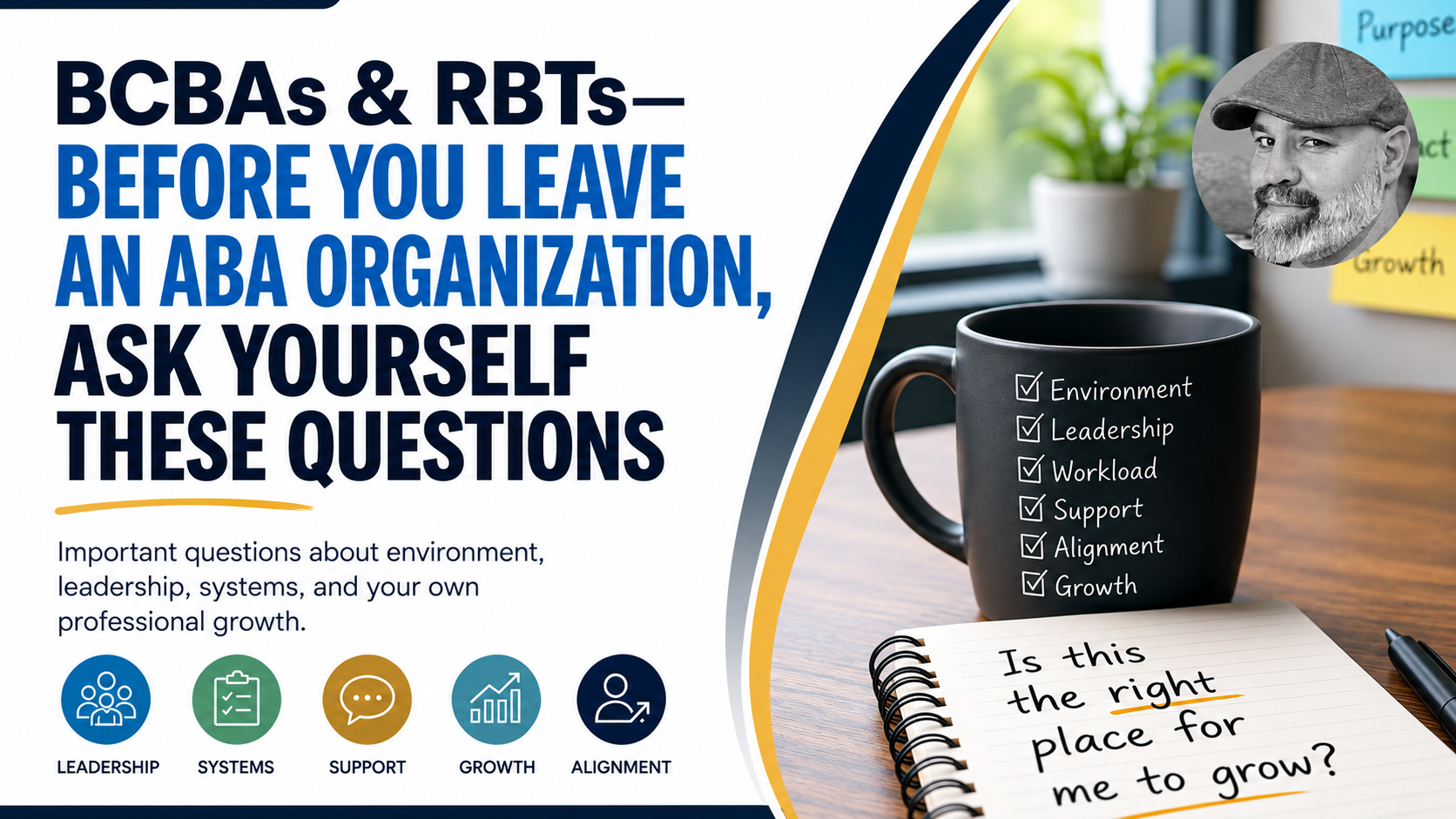
If, after reading this article, you still feel like your current environment may not be the right fit for you professionally, stick with me until the end. I’m going to share a resource I recently came across that I believe has the potential to significantly improve how behavior analysts and behavior technicians explore opportunities in the ABA field.
If you’ve been in the ABA field for any length of time, you’ve probably watched good people burn out.
Not lazy people. Not people who didn’t care. Good behavior analysts. Good RBTs. Good supervisors. People who entered the field wanting to help others and eventually found themselves emotionally exhausted, disconnected, frustrated, overwhelmed, or quietly wondering whether they even wanted to continue doing the work anymore.
Maybe you are one of those people.
As behavior analysts, we already know that behavior is influenced by the environment. That part shouldn’t surprise us. The better question is this: what about the environment is influencing performance?
Because “the environment” is broad. It’s leadership. Systems. Expectations. Feedback. Coaching. Reinforcement. Workload. Caseload size. Clarity. Organizational values. Available resources. The contingencies operating around people every single day. In the perfect world, these contingencies help us to feel valued and produce valued outcomes.
That’s why I think before somebody decides to leave an ABA organization, there are important questions worth asking first. Not just about the organization. About themselves, too. Because sometimes people are under-supported. Sometimes people are under-skilled. Sometimes both things are true at the same time.
Passing a Certification Exam Isn’t the Same as Being Ready for Practice
This is important because I think a lot of professionals quietly struggle with this reality. Passing the RBT or BCBA exam demonstrates competency toward a written standard. And sure, that’s an important step. But passing an exam does not automatically mean somebody is fully prepared for the realities of practice. It’s like my fighters (I’m a professional MMA coach) passing a written exam and then being expected to perform in the actual fight.
That’s not how performance works.
Many professionals leave training programs with strong declarative knowledge. In other words, they can describe concepts, define procedures, and answer questions correctly. But procedural fluency is different. Applying skills effectively in fast-moving, emotionally demanding, real-world environments requires coaching, repetition, feedback, reinforcement, modeling, and deliberate practice over time.
Certification does not automatically produce confidence under pressure, clinical judgment, emotional regulation, communication skills, leadership skills, time management, or fluency with difficult conversations.
Those things are developed. That means if an organization is going to successfully support consumers’ needs, it has a responsibility to continue developing people after certification. It also means professionals have a responsibility to continue developing themselves. Both matter.
And that naturally leads to an important question many professionals should ask themselves before deciding whether an organization is truly the wrong fit.
How were you actually developed after you entered the role?
How Were You Onboarded?
Seriously. Think about it for a second. How were you onboarded into your role?
A lot of professionals enter organizations excited to learn and grow, only to feel overwhelmed within the first few weeks because the organization never really built a system for development. Strong onboarding systems matter because they reduce errors, build confidence, improve retention, and help professionals contact reinforcement earlier in the process.
When onboarding is weak, people too often end up surviving rather than developing. Especially those newer to the field, which is a ton of folks!
Things worth asking yourself include:
- Were you gradually introduced into responsibilities?
- Did you receive clear expectations?
- Was coaching built into the process?
- Did somebody model important skills for you?
- Were you given opportunities to practice and receive feedback?
- Did leadership check in regularly during the transition?
- Were mistakes treated as learning opportunities or failures?
Throwing people into chaos and calling it “learning through experience” is not a development system. And honestly, onboarding is usually just the beginning. Even strong onboarding eventually breaks down if there isn’t an actual coaching system in place over time.
Is There an Actual Coaching System?

Not occasional correction. Not hearing from leadership only when something goes wrong. An actual coaching system that supports the generalization of learned skills into the natural environment. What Dr. Nic Weatherly and I call Deliberate Coaching.
Organizations that truly develop people usually have systems for ongoing support, performance feedback, reinforcement, and skill development.
People are not simply left alone until there’s a problem.
Questions worth considering include:
- Are supervisors regularly observing performance?
- Is feedback timely, specific, and actionable?
- Do people receive reinforcement for progress and effective performance?
- Are mistakes treated as opportunities for coaching?
- Do supervisors help people generalize skills over time?
- Are professionals encouraged to recruit feedback and support?
Those differences matter because people behave differently under different contingencies. Organizations built around coaching, development, and reinforcement eventually create very different cultures than organizations built mostly around pressure, urgency, and correction. And one of the biggest variables influencing whether people can actually benefit from coaching is workload.
Is the Workload Actually Sustainable?
This is clearly important and too often a big issue for many BCBAs. A caseload that feels manageable for one person may completely overwhelm another, depending on experience level, support systems, available resources, fluency, and life circumstances outside of work.
The real question isn’t whether somebody can survive the workload. People can survive a lot of things.
The better question is whether somebody can perform well, ethically, effectively, and sustainably over time. If you ask me, that’s a very different standard.
Some important questions to ask include:
- Is your caseload realistically manageable?
- Do productivity expectations allow for quality work?
- Are documentation expectations reasonable?
- Do you have adequate support and resources?
- Is there enough time built in for feedback, planning, and development?
- Are expectations adjusted as professionals gain fluency and experience?
Listen, surviving and thriving are not the same thing. I’ve been there and I’ve written extensively about it in books like Positional Authority Ain’t Leadership, because eventually, workload and systems always circle back to leadership.
Does Leadership Actually Match the Mission?
A lot of organizations talk about values. The real question is whether the day-to-day contingencies align with those values. Leadership influences culture. Culture influences behavior. And behavior influences outcomes. That’s why leadership matters so much in organizational environments.
Questions worth asking include:
- Do leaders model the behavior they expect from others?
- Do people feel psychologically safe asking questions or admitting mistakes?
- Does feedback help people grow, or mostly make people anxious?
- Do professionals feel developed and supported, or simply managed?
- Are there regular social validity measures in place to check the “pulse” of the stakeholders in the organization?
- Do leaders positively reinforce quality performance consistently and more than they correct errors?
- Are values actually reinforced operationally, or mostly discussed rhetorically?
People do better in environments where they feel valued, supported, and aligned with the mission. But organizations are only one side of the equation. Professionals also have a responsibility to evaluate themselves honestly. It’s important that you have self-awareness.
Now Ask Yourself Some Hard Questions Too
This part matters because not every professional challenge is entirely caused by the organization. Sometimes people genuinely need more support. Sometimes they need more skill development. Sometimes they need more feedback, more fluency-building, more organization, or better self-management systems. That’s why professionals also have to honestly evaluate themselves.
Questions worth asking include:
- Am I actively recruiting feedback?
- Am I implementing the feedback I receive?
- Am I practicing important skills outside of crisis moments?
- Am I self-monitoring my own performance?
- Am I communicating effectively with my team?
- Am I asking for support when I need it?
- Am I contributing positively to the environment around me?
- Am I continuing to grow professionally beyond certification?
Strong environments still require active participation from professionals.
Growth requires effort from both sides.
And once people begin evaluating both the organization and themselves honestly, they often start realizing something important.
Not Every ABA Organization Is Built the Same
This is just reality.
Some organizations invest heavily in onboarding, leadership development, coaching systems, mentorship, and staff support. Some are still trying to figure it out. Some environments help professionals grow stronger, more effective, and more connected to the mission over time. Some slowly drain people.

That doesn’t mean every difficult environment is automatically toxic. Growth requires challenge. Every organization will experience stressors and operational pressures. But there is a difference between an environment that stretches people and one that consistently pulls them away from the reasons they entered the field in the first place.
Fit matters. Leadership matters. Systems matter. Alignment matters. And unfortunately, many professionals feel stuck because exploring opportunities in ABA can feel risky.
AT A GLANCE
| Originally published: | LinkedIn, May 24, 2026 |
| About the organization: | 26 questions on onboarding, coaching, workload, and leadership |
| About yourself: | 8 questions, from recruiting feedback to growing beyond certification |
| Resource mentioned: | CertifyndABA (certifyndaba.com), a free job-matching platform for clinicians; the author says he became involved in it |
SOURCES & REFERENCES
| 1. | Gavoni, Paul. “BCBAs & RBTs — Before You Leave an ABA Organization, Ask Yourself These Questions.” LinkedIn. May 24, 2026. https://www.linkedin.com/pulse/bcbas-rbts-before-you-leave-aba-organization-ask-paul-qqk1e/ |
| 2. | Weatherly, Nicholas L., and Paul Gavoni. Deliberate Coaching: Optimizing Business Performance Through the Science of Behavior. KeyPress Publishing. July 2025. https://www.amazon.com/Deliberate-Coaching-Optimizing-Business-Performance/dp/B0FGDLF65S |
| 3. | Gavoni, Paul. Positional Authority Ain’t Leadership. January 2024. https://www.amazon.com/Positional-Authority-Aint-Leadership-Performance/dp/B0F3FM817Z |
| 4. | CertifyndABA. “The original job match for ABA.” Company website. Accessed October 5, 2026. https://certifyndaba.com/ |
| 5. | “CertifyndABA – Find Your Match Today.” YouTube video embedded in the original article. https://www.youtube.com/watch?v=oPJtlqQ70CY |






Join the discussion ▾